

Cybercab & Robotaxi: Concerns of a California Lemon Law Attorney
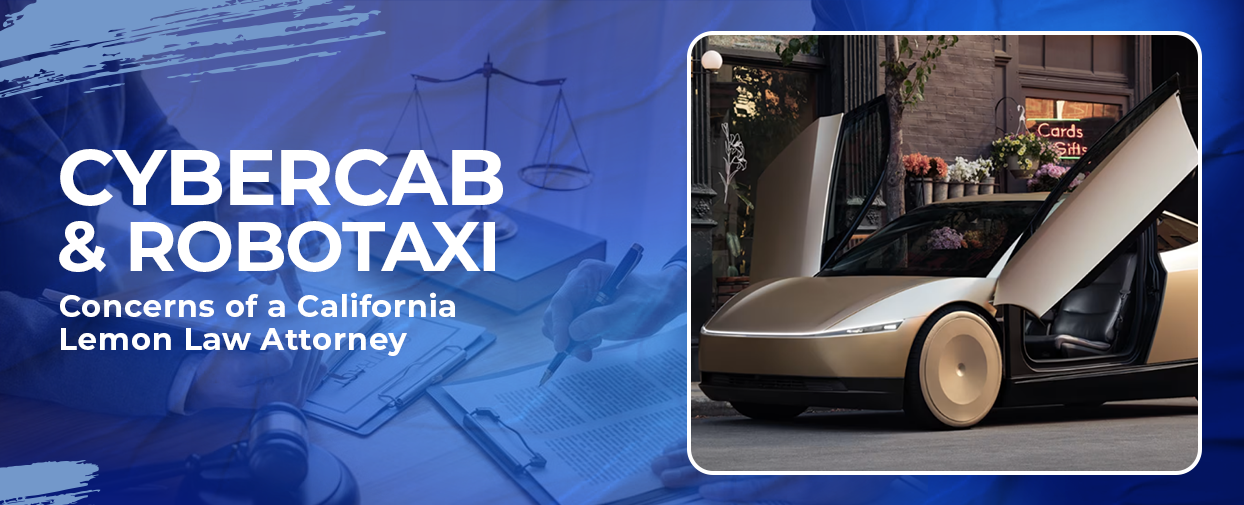
Cybercab is set to transform how we travel. Autonomous vehicles, including robotaxis from companies like Tesla, let consumers summon a driverless car with a simple tap. But recent incidents reveal serious risks. In one widely reported case covered by Futurism, a Tesla robotaxi became stuck driving in circles in a parking lot, unable to exit until remote assistance intervened. While the technology offers convenience, these failures show serious safety concerns and introduce new legal challenges that California lawmakers must evaluate.
From a California Lemon Law Attorney’s perspective, one critical question stands out:
“If no human driver is in control, who is legally responsible when a defect causes failure or injury”? Yoseph Rixit.
How Cybercab Works and Why Liability Is Different
Unlike traditional vehicles, a Cybercab does not rely on a human driver. Instead, it depends entirely on integrated autonomous systems that include:
- Artificial intelligence software
- Cameras and visual recognition systems
- Radar and lidar detection technology
- Automated steering, braking, and acceleration controls
- Live navigation and decision-making algorithms
In an autonomous vehicle, every critical driving function is controlled by software rather than a human driver. This shift fundamentally changes how liability is evaluated under California law. Cars without drivers might pose significant risks that can fall under the legal framework.
Are Automatic Car Defect Cases More Difficult to Prove?
Defects in driverless cars are often more complex than those in traditional vehicles for several reasons:
Software Controls Core Safety Systems
In an automatic car, braking, steering, and collision avoidance are all controlled by software. Unlike traditional cars, there’s no human driver to correct mistakes, so any software error can directly affect safety.
Failures May Be Intermittent
Some issues only appear under certain conditions, like heavy traffic or bad weather. This makes it harder to spot and prove the problem, since it doesn’t always happen consistently.
Updates Can Change Vehicle Behavior
Software updates can improve performance, but they can also introduce new problems after you’ve already purchased the vehicle, creating additional challenges for proving a defect existed at the time of sale.
Defects May Affect Entire Fleets
A single coding error can impact hundreds or even thousands of vehicles at once. This means a widespread safety risk exists, but tracking and documenting it can be more complicated.
Because of these factors, holding manufacturers accountable requires careful evidence gathering and legal expertise. Consulting a California Lemon Law Attorney is essential to navigate these complex cases and protect your rights.
When Autonomous System Failures Become Legal Concern
Under California lemon law, vehicle manufacturers can be held liable for defects involving:
- Design defects (flaws in system architecture)
- Manufacturing defects (errors in production)
- Failure to warn (inadequate disclosure of known risks)
With driverless cars, defects often involve:
- Software bugs that cause unsafe driving decisions
- Sensor failures that misinterpret road conditions
- Unexpected disengagement of the autonomous mode
- Braking or steering irregularities
- Over-the-air updates that introduce new safety issues
If these problems substantially impair the vehicle’s use, value, or safety, they may qualify as defects under California’s Song-Beverly Consumer Warranty Act, commonly known as California Lemon Law. This law not only protects consumers against manufacturers but also aids in compensation.
How California Lemon Law Protects Car Owners
California Lemon Law protects consumers who purchase or lease defective vehicles. If a vehicle has a substantial defect that the manufacturer cannot repair after a reasonable number of attempts, the consumer may be entitled to:
- A vehicle replacement
- A full refund
- Compensation for damages
These protections ensure that consumers are not left dealing with unsafe or unreliable vehicles on their own. Still, many vehicle owners may not realize when their situation qualifies under the law, making recognition of warning signs essential.
Warning Signs Your Tesla May Qualify Under California Lemon Law
If you own or use an autonomous vehicle, pay attention to warning signs such as:
- Unexpected braking or acceleration
- Failure to detect nearby vehicles or obstacles
- System shutdowns or warning alerts
- Autonomous features are not functioning properly
- Repeated repair attempts for the same issue
If your vehicle exhibits any of these issues, don’t ignore them; your safety could be at risk. In this situation, contacting a qualified lemon law lawyer can help you.
Contact a California Lemon Law Attorney
With self-driving vehicles getting more common, the legal responsibilities of manufacturers must also evolve. Defects in such vehicles present unique risks.
California Lemon Law exists to protect consumers when vehicle defects compromise safety, reliability, and performance. A California Lemon Law Attorney can help you understand your eligibility for compensation.
The team at Merak Legal is committed to helping consumers understand and pursue their legal rights.
免责声明:本内容仅供参考,不构成法律建议,也不建立律师-客户关系。您的案件可能与此处讨论的案件不同。请始终向专业律师寻求法律建议。
驱动我们的力量

透明度
没有法律黑话,没有隐藏条款,只提供您最熟悉语言的清晰沟通。

专业实力
兼具制造商内部视角与丰富诉讼经验,胜算更高。

可及性
正义应当触手可及。双语服务与“不赢不收费”,让维权变得更简单。
从免费案件审查开始
请填写下面的表格,我们将在24小时内回复您。分享一些关于您车辆问题的细节,我们会告诉您是否有案件——无需任何附加条件。